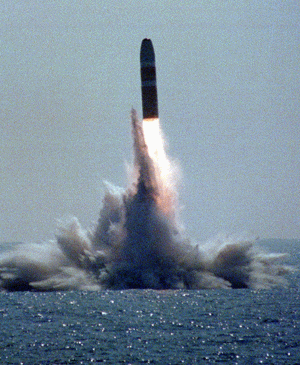
 U.S. ballistic missile submarines (SSBNs) have done a great job maintaining America’s second-strike nuclear capability–lurking at sea, undetected, every day. But their era of invulnerability is coming to a close; once SSBNs lose their ability to hide in the oceans, these single-purpose arsenal ships are finished.
The sea is already a crowded place, and hiding is becoming far harder. By 2030, when the first new SSBN(X) enters service, hiding will be near impossible.
Some, of course, disagree. Budget-cutters at the CATO Institute, in a recently released call to shrink the nation’s nuclear triad down to a sub-led monad, write in their recently-released paper “The End of Overkill: Reassessing U.S. Nuclear Weapons Policy“:
“Given present Russian and Chinese ASW capabilities and their limited efforts to improve them, threats to the survivability of the U.S. SSBNs at sea remain a distant prospect.”
Well….A lot can happen in 15-20 years. But for any undersea boat that depends on stealth–and operates outside the cozy confines of the Washington DC–I am certain survival will be far more difficult than most purveyors of conventional beltway wisdom expect. But don’t take my word for it. Here’s CNO Greenert in DefenseOne, talking about how the undersea world is changing:
“Military and commercial activity under the ocean is rapidly increasing, which could detect or conflict with our forces’ operations or create new threats to our interests. Other nations are fielding increasingly capable and longer-range submarines while companies and scientists are sending unmanned vehicles and sensors throughout the ocean to find everything from fish stocks to oil deposits.”
U.S. SSBNs have gone unchallenged-and largely undetected-for generations, so it is easy for the Navy and others to blithely assume that America’s ownership of the subsurface domain will continue. By the time America and the UK starts deploying the new SSBNS in the mid 2030s, it will be hard for anything–ANYTHING–to move undersea without notice.
The undersea world 0f 2030 will be complex, with multiple submarines, sensors and aircraft from a number of non-aligned countries operating in close proximity, groping about near traditional SSBN stomping grounds. And I strongly suspect unmanned underwater vehicles will be out there fighting each other as well, making the undersea domain a complex, confusing kind of gladiator academy.
The confusion and conflict in the seas of 2030 will make us long for the perilous days when it was either the Russians or a few known NATO friendlies operating out there in the deep.
So I must ask my readers: Is this an appropriate environment for America’s second-strike capability (or as CATO would suggest, ALL the U.S. nuclear deterrence forces)? Given my bleak assessment of the undersea domain, missiles planted in the plains of Montana, Wyoming and North Dakota, under the watch of a few EM Rail Guns and other missile defenses, seems a far more secure strategic option.
I think, by 2030, the single-purpose, “undetectable” SSBN will be an anachronism, better suited to serve as a big modular “Unmanned Underwater Vehicle” mother ship than a dedicated ICBM carrier/second strike platform.
A more interesting strategic option would be a commitment to distribute undersea nuclear weapons between a larger number of platforms–by endowing the Virginia Class SSNs with a full suite of modular capabilities, including the employment of ballistic missiles.
We are headed in that direction.
Look. If we take CNO Greenert at his word–I do–that modularity is the future, then why are we even bothering with the single-purpose SSBN? Let’s go back to CNO Greenert’s initial call for modularity, “Payloads Over Platforms: Charting a New Course.” In that, he wrote:
In Sailing Directions and Navigation Plan for 2013 , I highlighted my intent to “expand the reach and effectiveness of ships and aircraft through new payloads of weapons, unmanned systems and sensors.” The use of modular payloads that can be changed out over a platform’s life offers an effective and affordable way to maintain our adaptability and warfighting advantage against evolving threats.
And he continued the discussion, saying we needed to change the way we look at platforms:
Taking advantage of that learning curve while ensuring each hull or airframe has relevant capability for its time requires that we look at platforms more as trucks. The truck will load and plug in successive generations of modular payloads as it goes through decades of serial production. To support that approach, we would increasingly employ standardized interfaces to plug in new sensors, weapons, and unmanned systems; and standardized links to communicate with them if they leave the truck. The design of future platforms also must take into account up front the volume, electrical power, cooling, speed, and survivability needed to effectively incorporate new payloads throughout their service lives.
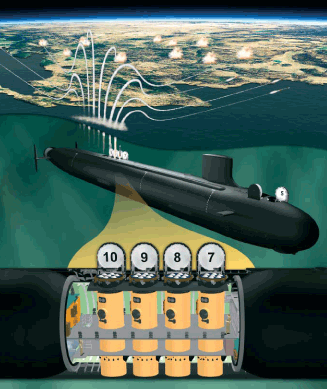 As far as I am concerned, that leaves one option for the sub fleet–endowing the Virginia Payload Module (VPM) with the capability to accept a ballistic missile.
I’d like to think CNO Greenert hints at this in his DefenseOne article:
We will expand the capacity of our next block of Virginia submarines to deploy unmanned vehicles with the Virginia Payload Module, which adds a section of hull with four large (7-ft diameter) payload tubes to the current submarine design. These large payload tubes will also carry missiles and will replace the current missile capacity that will be lost when our current guided missile submarines retire in the next decade. (Emphasis my own)
Notice how he doesn’t expressly limit the VPM to just the Tomahawk? In my jaundiced eye–and knowing that the first SSBN will retire in 2027 (more than a decade from now), the CNO is doing his best to avoid an unwanted strategic debate. A cursory look at VPM dimensions suggests it could accept a ballistic missile somewhere along the lines of an old 73 inch diameter Trident I (C4). Or a reduced-length 83 inch diameter Trident II (D5). (Full disclosure: I have discussed this option before, here and here.)
Now, I know, plenty of number-crunchers have already been deployed to tell me I am wrong, that the VPM can’t take a ballistic missile, and that the most “cost-effective” route is to build a new sub around the legacy Trident missile rather than see another missile get designed and built and approved for service. Got it. Still, I can’t see Lockheed Martin needing 10 years to roll out a smaller Trident variant. Sure, a new, smaller missile might loose payload/range but….If these missiles are distributed on a number of SSNs, then do we really need much range beyond 4000 miles? And won’t range extend as modern technology shrinks motors, warheads (now this here is your cost-driver, yes?), countermeasures, etc.? (Frankly, with the Air Force thinking about replacing their legacy missiles at about the 2030 timeframe, maybe it is time somebody put their foot down and forced the Air Force and Navy to go joint and share the development cost for a new rocket.)
Anyway. If we are really wedded to the idea of maintaining a second strike capability undersea, then the best way to do it is to provide platform redundancy (beyond the two missile-packed SSBN(X) expected to be on constant patrol) and do our best to complicate the targeting process. If we start building Block V Virginia Class SSNs with the new payload module now, by 2030, a whole lot more of those potentially “missile-ready” platforms will be at sea. To me, dealing with 20-30 Submarine Launched Ballistic Missile (SLBM)-ready subs is far harder than finding and fixing one or two.
Decoupling sub-launched ICBMs from their exclusive launch platform offers greater security for our sea-borne nuclear deterrence and offers greater strategic flexibility. It also gives America the opportunity to reduce the number of nuclear weapons fielded and distribute those missiles across a far wider number of platforms–allowing us to easily scale our deployed SLBMs according to need. Might it raise tension? Possibly. I’m certain the strategic arms limitations people won’t like the prospect of having a wider array of SLBM-ready platforms, but, well, tough. The world of 2030 is going to be far different from the Cold War world today’s moldy cadre of deterrence wonks grew up in.
An SSBN, as we conceive of it today, is locked into the SSBN mission, and yet, a single-purpose arsenal ship is probably not something we really want to have sailing in the fractious seas of 2030 (Now, if the actual intent is to have a handful of big undersea UUV “mother ships” deployed in the 2030s, then, Navy, by all means, make the case!). But, if the Navy is simply looking to preserve a second-strike option, endowing the SSN fleet with SLBM capability increases the fleet’s overall capability, adds strategic options and allows far more dramatic cuts in the nuclear arsenal. Giving the Virginia Class boats SLBM capability makes sense.
Modularity is where the U.S. Navy is going. Might as well bite the bullet and get to it.


{ 14 comments… read them below or add one }
I believe the authors basic premise is flawed. The increase in traffic in the world’s oceans increases ambient noise levels and make submarines less detectable acoustically. In terms of non-acoustic detection, the presence of increased commercial traffic also would serve to mask the presence of military submarines. Searching for submarines in a high traffic area such as the Mediterranean/South China is quite a bit more difficult than the North Pacific (accounting for differences in oceanographic factors: water depth etc.).
Fantastic idea which would not take away capability and still give us the most advanced SLBM capability in the world. Virginia modularity is a real answer to what the world will be like in 2030.
I’ve heard that a Trident Submarine’s Hull is designed and built so sensitive that
it can detect a ship or submarine clear across the Atlantic Ocean. The sensors in
the hull. Where can I read that? Thanks.
People have been saying that the oceans will be turned to glass for decades. That is, the ability to remain submerged and undetected will not be possible due to new technology ranging from lasers to acoustics. It’s still not happened and I strongly doubt it will for many decades to come. It’s not at the tipping point any more than it was in 1970.
To develop a new ICBM is unbelievably more expensive than you believe. That is why the D5 has a service life extension. Changing the missile alone to support a VPT version would negate most of the savings of sticking to a VA class. Now let’s factor in that every Virginia would now also need a full complement of nuclear missile personnel and training. More dollars since it will be across more boats. Finally, we only house the ICBM carrying boats in two ports… Think of the long term home porting changes for all the VA class boats. We are simply not going to homeport ICBM carrying boats in a normal base with easy access from a terrorist threat anymore.
Finally, and the most important is, it’s simply not reasonable from an engineering perspective. The VA class reactor and propulsion system is designed for a small fast attack submarine. It’s not a one size fits all. Its like taking the engine from a Camry and sticking it in a F-350. It’s going to be underpowered – and no you can’t just up the rating, that’s now how it works for those not familiar with cores. Oh, and forget the 30 year core life of the VA class. The auxiliary systems such as the hydraulics, air conditioning, ballasting, etc. will all require a redesign to support ICBMs and the corresponding compartment size increases.
After all that, hell – just start fresh with SSBN(X) which is actually designed for the mission. Making fleets of Swiss army knives instead of buying a handful of each type of tool might seem like a great idea, but it just makes you a below average platform at EVERYTHING instead of excellent at each specialty.
I cannot speak for the other commenters but I do appreciate the speculative / opinion nature of blogs; however, people in official places do read articles in blogs and pay attention so a level of diligence in expression and disclaimers should be observed.
Nuclear deterrence is in the category of ‘you cannot afford to goof’ or permit ‘ordinary accidents’ so I would caution against novelty or change unless no other options exist. I believe its sufficient to remind people that only one nation has employed nuclear weapons in conflict and if you’re concerned about irrational behavior then don’t mess with them. As a sensors geek, I expect the seas to remain blissfully opaque to sensing for physical means I am aware of for the foreseeable future. Certain aspects of missiles are not subject to technology progress; nuclear warheads aren’t going to get smaller (for set yields) and the reentry heatshielding isn’t an area for improvement either. If you worry about gross ASW overmatch by a foreign navy, D5 has the range to address the plausible targets from pier-side so you could operate from CONUS waters as bastion.
As to the proceedings article; I respectfully disagree with your expectations regarding the DF-21d. I would place bets on its effectiveness over the effectiveness of any expected counter on the US side at this time. It’s clearly a ‘Sputnik Moment’ and I do not believe the USN / USG is sufficiently concerned to follow the appropriate response of revitalizing the S&T efforts and programs as needed to create credible responses.
Great comments, folks. Really appreciate them, and I do hope ya’ll will engage online or off. These are my opinions and do NOT reflect anything beyond curiosity and a desire to promote healthy discourse. Ya’ll should be commended for engaging so constructively!!
So here are a few thoughts:
First things first–J_Kies, if I were king, I would move immediately to put ICBM management under the same management. SUBSAFE standards have done well for us, and, in my imaginary world, I’d make the Navy managers the effective stewards of every nuclear-tipped rocket in the arsenal. The additional costs incurred are a small price to pay for superior management!!!
Now, I’ve written about Trident II reliability in regards to Prompt Global Strike (See my “Fainting Couch” article in Proceedings). I understand the reluctance to retire a program that is performing well, but there’s a reason why we walked away from the bow and arrow and the MK 1 Sandstone Rock–even though both weapon systems enjoyed a high rate of successful launches! (El Cid, didn’t Lockheed and Alion team up to do some work on sub-launched intermediate-range missiles a few years ago?)
I do disagree about the need to clearly differentiate nuclear and non-nuclear platforms. Strategic ambiguity is a good asset–and as more nations impose upon us the challenge of strategic ambiguity, reciprocation makes some sense. (Also, if making a clear split between non-nuclear and nuclear forces is such a big deal, then why the !@$# are we still not welcome to moor at New Zealand ports?)
Worried about mixing missions? Fine, dedicate a boat or two to the strategic mission when required (I think you’ll see something similar with the LCS–sure, it’s a fully modular platform, but I’ll bet certain ships get to be known as MIW specialists and others more frequented by Special Operators or ASW folk–sure, they’re modular, and can take on any mission, but a crew can only absorb so much specialized doctrine, so they’ll find their strength and generally stick to that). That said, there is strategic utility in having the ability to “mix and match” or accept an entirely new mission if needed. No need to do so unless necessary, though.
Now, I do chafe a little at the practices imposed by our compliance with deterrence theory. Deterrence is a language (or habit) learned by rivals over the course of a long period of confrontation. China is, to some extent, making a cottage industry out of exploiting doctrinal holes. Deterrence is one of those. That is why I have long been a champion of mixing it up a bit–nothing wrong with imposing doubt and uncertainty upon a rival–At least until such a point as when they decide they’re happier living with standard deterrence practices. Until that point, the habits that have solidified around deterrence theory will be seen as just another pretension to exploit.
Sometimes the quickest route to stability is though the imposition of a little judicious employment of instability.
Thoughts?
A couple of points of disagreement from one of the people that worked on Trident II in my youth and having current emphasis on physics and engineering as constraints on policy.
1) Trident II / D5 has the singular best reliability of any weapon system in the DOD. It has an entire industrial base, personnel expertise / tradition / training and a launcher that all support that performance record. Walking away from that entire system is fraught with hazards in engineering and capabilities that should cause anyone to question the necessity and wisdom of such a decision. Arguably based on test representation and alert status, the US has an operative Monad of credible nuclear deterrence today, the ‘Boomers.
2) Nuclear deterence is a function different from warfighting, its war avoidance. As such its inappropriate to invoke the ‘no single mission warfighter’ mantra. By design we don’t want the boomers firing in anger and potential strategic confusion of SSN missions with nuclear responses is entirely unacceptable.
3) Given the Subsafe standards, any new missile ejection approach/ new missile are hugely different for the submarine community than for less diligent communities. To achieve Subsafe standards, any new missile / launcher will likely replicate if not exceed the historic Trident / Ohio timelines / costs with scalars for learning curves that reflect abandonment of the experience base. The USAF safety record with ICBMs is not enviable and you should not wish to cohabit with their engineering products.
4) Warheads are mostly a distraction in terms of costs; NNSA is billing for the capability to have the scientific / engineering means to have safe and secure warheads rather than some unit costs per device. LEPs are likely a singular cost regardless of the number of units involved.
@Craig
Ballistic capability may be an “if” – but it is the main reason behind doing the VPM. If you’re just going to stick with cruise missiles, then you can add more of the 6xVLS modules of the Block III Virginias. Technologically it’s a hybrid between the standard Ohio tubes and the SSGN modification, so as rocket science goes, it’s on a better-trod path than most. Still, it seems JROC are dead set against it.
As for a combined sub-launch and silo-launch warhead, it’s gone beyond the enquiry stage, the IW-1 warhead in the Energy Department’s 25-year plan would do just that. However the USN argue that it’s $14bn that doesn’t need to be spent, when they could spend $3-4bn on SLEPing W78/W88. I’m not quite sure how that 25-year plan fits with the 2010 Nuclear Posture Review, which said no new warheads. No doubt it will be presented as a safety update like the B61 Mod 12, which has shown classic requirements creep. It started off as a SLEP and unification of the existing Mods 3, 4, 7 and 10, then they wanted to replace the parachute with a Paveway-style tail kit, but that meant the launch aircraft couldn’t escape in time so they had to adjust the fuzing and casing and then they wanted to use the space formerly occupied by the parachute for an anti-theft device and soon the SLEP of 400 units ended up costing $10bn. It would be cheaper to build replicas in solid gold.
As another data point, NNSA have estimated it would cost $12bn to build a new warhead for ALCM and people are talking about $20-30bn to replace the ALCM missile itself. One can imagine that a new ballistic missile would cost at least as much.
You still have signalling problems with a fighter-bomber submarine versus separate SSNs and SSBNs. There’s all sorts of reasons why the two are best kept separate.
You may also find this useful, particularly pp11-12 : http://www.fas.org/sgp/crs/nuke/R41464.pdf
Personally, I keep wondering when the Navy is going to get around to developing the VLT (Vertical Launched Torpedo). I’d really like to see what kind of performance you could get out of a super-cavitating torpedo the size of a Trident II.
Hi El Cid. Assuming one could actually swap out ballistic missile capability on the Virginia Payload Module (a big if) it certainly would be interesting to at least enquire about the possibility of forcing the Air Force and Navy to collaborate on a modular ballistic missile (one maybe longer ranged one for land-based deterrent and a smaller (fewer stage?) one for the VPM). Air Force is already making rumblings about new warhead designs, so, why not kill two birds with one “joint” stone?
Also, we’ve swapped warheads about before; any reason why we can’t use a W88 on a new missile, a la the W87? If I recall correctly, they went from a big MIRVed land-based missile to a non-MIRV alternative (Apologies, as I haven’t followed the issue closely–they went from Peacemaker to Minuteman or something like that.)…
I hear you on the PGS business and register the importance of clear signals. Agree all–that’s why I’m NOT arguing for a nuclear cruise missile, but for a ballistic alternative. I want it difficult for a rival to distinguish a launch platform versus a launch vehicle….know what I mean?
Thx for the comment.
The killer with any change to the missile is the warhead – they are expensive, they take a long, long time to develop (the British recently estimated it would take them 15-20 years to do a TLAM-N replacement) and you run into all sorts of problems with international treaties that it’s really in your interests not to break. Simply reusing the C4 warhead isn’t an option as such an old design is no longer considered safe – look how much the USAF has spent on safety updates to its air-dropped warheads.
I think you’re reading a bit much into Greenert’s comments – the point of the truck+payload concept is that a submerged VLS tube doesn’t just mean Tomahawks, but LRASM, MALD, drones etc etc. And they’ve made many explicit statements about how they intend to replace 4×154 SSGN tubes with 22×28 VPM tubes, I think that’s all he was referring to in the statements you quote.
Of course, that assumes the VPM actually happens – last I heard the funding had been withdrawn although I haven’t been following every twist and turn of the debate. Sure, the point of VPM is that it is intended long-term as the home for Prompt Global Strike, a conventionally-armed ballistic missile along the lines of the DF-21D, but again that seems to be in limbo at the moment. PGS seems to be out of favour since the successful flights of the X-51, the momentum seems to be behind the air-launched High Speed Strike Weapon derived from the X-51. I suspect part of it is the desire to clearly differentiate between ballistic missiles as carriers of nukes and conventionally-armed weapons. That kind of signalling is vitally important, it was a major reason for the withdrawal of TLAM-N. If the red team don’t know if an incoming Tomahawk strike has instant sunshine on board, they have to assume the worst and will tend to escalate. Which you don’t want to happen. So you could have a PGS-N, but I doubt it will happen.
I love the idea of giving a SLBM capability to SSNs. I don’t think they doom and gloom about sub steath is realistic however, at least not short of a major revolution is detection technology. I recall lots of projections from the 1980s that various technologies like satellites with MAD technology would “make the oceans opaque”. Easier said than done, and that is unlikely to change, even in the next 50 year.
Personally I think the cost of the SSBN(X) program will force Congress to take another path, you simply cannot spend the same amount on the first Ohio replacement sub as you spend on the USS Gerald Ford ($12B and rising). Congress with choke on it before they authorize and appropriate that much.
Thanks! It will be interesting to see how this plays out. My real sense is that SSBN is inevitable; I cannot see the Navy giving the SSBN up without obtaining something for it, and I cannot see the aerospace companies fighting the naval sub fabricators for nice, high margin R&D contracts right now….
Very good analysis…Sold me on VCS modularity vs. new designed SSBN…I think Lockheed can design, prototype, test a smaller Trident in 10 years for less than $3B SSBN(X)…or NSSBN…